


skilled worker visa Germany from India
Explore all ways to enter Germany from India in 2026. From the Chancenkarte to Ausbildung and EU Blue Cards, Dream2Europe helps you start your journey today!
AWARENESS
Dr. Mushtaq Ali
2/14/20266 min read
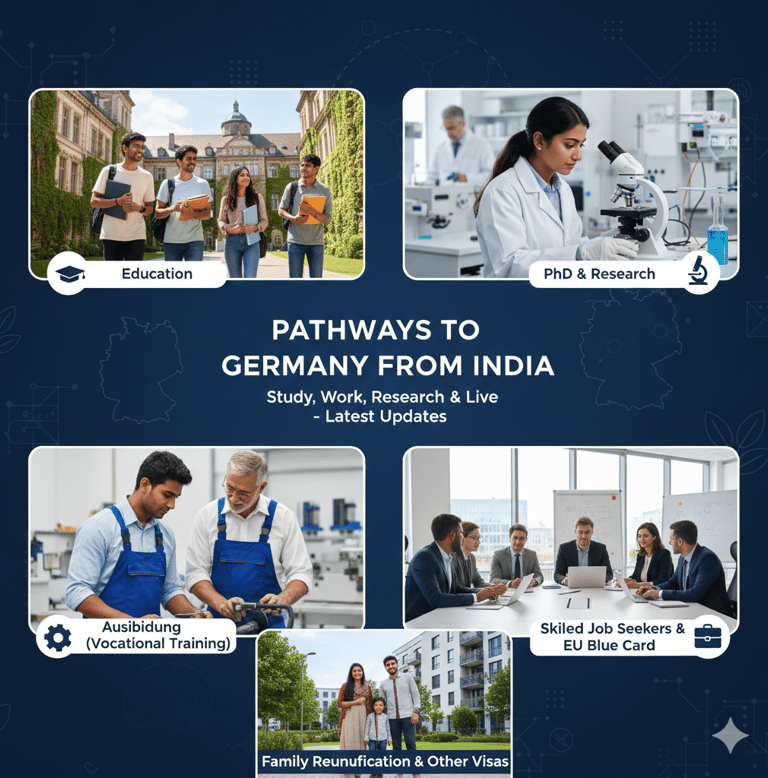
Germany has firmly established itself as a premier destination for international talent, students, and professionals, drawing individuals from India with its world-class education system, robust economy, and high quality of life. The German government has been proactive in streamlining immigration processes and introducing new policies to address its skilled labor shortage, making it an increasingly attractive option. This comprehensive guide details the various avenues for Indians to move to Germany, highlighting recent updates and the exciting prospect of the Chancenkarte (Opportunity Card).
1. Education: The Gateway to German Excellence
German universities are renowned globally for their academic rigor, research opportunities, and often, tuition-free or very low-cost education, especially at public institutions. This makes studying in Germany a highly sought-after option for Indian students.
Undergraduate and Postgraduate Studies (Bachelor's & Master's):
Requirements: A recognized higher education qualification (e.g., Senior Secondary School Certificate for Bachelor's, Bachelor's degree for Master's), proof of German or English language proficiency (depending on the program), sufficient financial means (usually shown via a blocked account or scholarship), and a Statement of Purpose. For some Indian degrees, a Studienkolleg (foundation course) might be required before starting a Bachelor's.
Process for Indians: Apply directly to universities, secure admission, apply for a National Visa (D-visa) at the German Embassy/Consulates in India.
Recent Updates: While the core process remains stable, there's an increasing push for digital applications. The cost of living proof required for the blocked account is adjusted annually (currently around €11,208 for one year). Post-study, graduates can obtain an 18-month Job Seeker Visa to find employment related to their qualification.
PhD and Research:
Requirements: An excellent Master's degree, a strong research proposal, and often a supervisor's acceptance letter. English is very common for PhD programs.
Process for Indians: Secure a supervisor, often apply directly to faculties or research institutes. Visa application is similar to other long-term study visas.
Opportunities: Germany boasts numerous research institutes (e.g., Max Planck, Fraunhofer) offering funded PhD positions. The visa process is generally smoother for recognized researchers.
2. Vocational Training (Ausbildung): Bridging the Skills Gap
Ausbildung is a unique German system combining practical on-the-job training with theoretical instruction at a vocational school. It's an excellent pathway for those who prefer hands-on learning and direct entry into skilled trades.
Sectors: Highly sought-after in healthcare (nursing), IT, crafts (electricians, plumbers), hospitality, and mechanics.
Requirements: Minimum of a secondary school leaving certificate (usually Class 10 or 12 equivalent from India), good German language skills (B1/B2 often required, as instruction is mostly in German), and often an initial internship to demonstrate interest and aptitude.
Process for Indians: Find an Ausbildung position with a company, secure a contract, and then apply for a vocational training visa.
Recent Updates: Germany has actively been promoting Ausbildung for international applicants to combat skilled labor shortages. The process has been somewhat streamlined, and there's growing awareness and support for international trainees. Wages during Ausbildung are modest but cover living costs.
3. Skilled Job Seeker Visas & Employment Visas:
For professionals with recognized qualifications, Germany offers several avenues to enter its robust job market.
EU Blue Card:
Requirements: A German or recognized foreign university degree, a binding job offer in Germany, and a minimum gross annual salary threshold (adjusted annually, currently around €45,300, or €41,040 for shortage occupations like MINT fields).
Benefits for Indians: Faster processing, easier family reunification, and a quicker path to permanent residency (21-33 months).
Recent Updates (Key for 2024 onwards):
Lowered Salary Thresholds: The minimum salary requirements for the Blue Card have been significantly reduced, making it accessible to more professionals.
Expanded Eligibility: More professions are now eligible, including areas like nursing and teaching, even if the degree is not strictly academic.
Relaxed Experience Rule: For certain IT specialists without a university degree, several years of relevant professional experience can now substitute for a degree.
Job Mobility: Easier movement between EU countries with a Blue Card after 12 months.
General Skilled Worker Visa:
Requirements: A recognized German or foreign qualification, a binding job offer matching your qualification, and often proof of German language skills (though not always mandatory if the job is in English). No specific salary threshold, but the salary must be comparable to local wages.
Process for Indians: Secure a job offer, get your foreign qualification recognized (via Anabin database or ZAB), and apply for the visa.
Recent Updates: The new Skilled Immigration Act further clarifies and streamlines the process, emphasizing qualification recognition.
Job Seeker Visa:
Requirements: A recognized German or equivalent foreign university degree, sufficient financial means to cover living costs for six months, and health insurance.
Purpose: Allows you to enter Germany and search for a job for up to six months. If successful, you can convert to an employment visa in Germany.
Recent Updates: Remains a popular option, especially for highly qualified individuals from India who prefer to search for a job while physically present in Germany.
4. The Chancenkarte (Opportunity Card) – The Game Changer for 2024
The Chancenkarte is a significant new initiative under Germany's updated Skilled Immigration Act, designed to attract non-EU skilled workers without a prior job offer, based on a points system. It's anticipated to be implemented in 2024.
How it Works (Points System): Applicants from India will need to meet certain criteria to earn points. Key factors include:
Qualification: German or recognized foreign degree/vocational qualification (points awarded based on recognition level).
Professional Experience: Years of relevant experience in a qualified profession.
German Language Skills: Levels from A1 to C2 will earn different points.
English Language Skills: B2 or higher.
Age: Younger applicants receive more points.
Connection to Germany: Previous stays, family in Germany.
Spouse/Partner Qualification: If accompanying spouse/partner also meets criteria.
Shortage Occupations: Points for professions on Germany's shortage list.
Benefits for Indians:
Job Search Flexibility: Allows entry into Germany for up to one year to actively search for a qualified job.
Part-time Work: Cardholders can work part-time (up to 20 hours per week) or undertake trial jobs during their search period to support themselves and gain experience.
Simplified Entry: Potentially less stringent than a traditional Job Seeker Visa, focusing on a broader range of skills and a points-based selection.
Process (Expected): Apply for the Chancenkarte visa from India, demonstrating sufficient funds for living costs, health insurance, and meeting the points threshold. Upon arrival, convert to the Chancenkarte residence permit.
5. Au Pair & Volunteer Programs:
While not primary immigration routes, these options offer a cultural immersion experience, particularly for younger individuals from India.
Au Pair Visa:
Requirements: Typically for individuals aged 18-27, basic German language skills (A1 minimum), experience with childcare, and a host family agreement.
Purpose: To live with a German family, help with childcare and light housework, and improve German language skills.
Recent Updates: No major structural changes, but continuous demand for au pairs. It's a stepping stone for cultural exchange.
Volunteer Programs (e.g., FSJ, BFD):
Requirements: Varies by program, often for individuals under 27-30, with a focus on social, ecological, or cultural work.
Purpose: To gain experience, contribute to society, and improve German skills.
Benefits: Provides a living allowance and often accommodation.
6. Family Reunification:
For Indian nationals who already have family members residing legally in Germany, family reunification remains a crucial pathway.
Spouse Reunification:
Requirements: The spouse in Germany must hold a valid residence permit (e.g., Blue Card, skilled worker visa, permanent residency). The applicant spouse often needs to demonstrate basic German language skills (A1 level) before entering, though exemptions exist (e.g., for Blue Card holders' spouses).
Recent Updates: The updated Skilled Immigration Act has made family reunification for skilled workers (especially Blue Card holders) significantly easier and faster, removing many previous hurdles. Spouses of skilled workers can often start working immediately upon arrival.
Child Reunification:
Requirements: For minor children joining their parent(s) in Germany.
Recent Updates: The process for child reunification also benefits from the overall streamlining for skilled workers.
Important General Considerations for Indians:
Visa Application: All long-term visas must be applied for at the German Embassy or one of the Consulates General in India.
Qualification Recognition: For professional pathways, having your Indian qualifications recognized (via Anabin database, ZAB, or relevant professional bodies) is often a critical first step.
German Language Skills: While some programs and jobs are in English, learning German significantly enhances opportunities for integration, job searching, and daily life. It's highly recommended.
Financial Proof: Demonstrating sufficient funds for your stay is crucial for almost all visa categories. This is often done via a blocked account (Sperrkonto), scholarship, or an employer's declaration.
Health Insurance: Mandatory for all residents in Germany.
Conclusion:
Germany's commitment to attracting international talent, particularly from countries like India, is evident in its evolving immigration policies. The new Chancenkarte, combined with streamlined processes for the EU Blue Card and Ausbildung, opens up unprecedented opportunities. For individuals from India with the right qualifications, skills, and determination, Germany offers a promising future in a vibrant, innovative, and welcoming society. Planning, language preparation, and diligent application are key to successfully navigating these diverse pathways.
Contact
Reach out for career or hiring support
Phone
info@dream2europe.com
+49 17647776786
© 2025. All rights reserved.